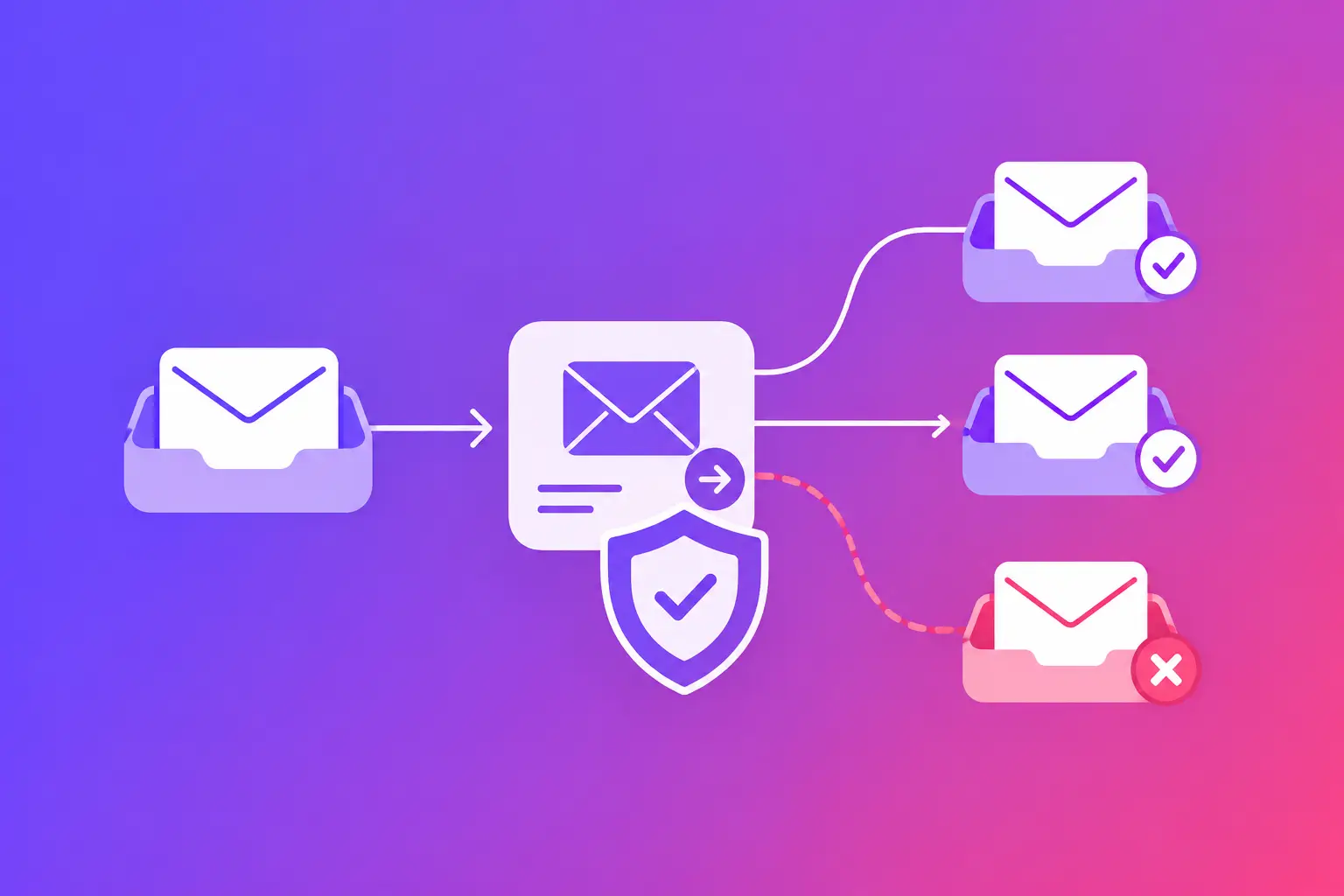
A customer says they never received your invoice. Your sent folder shows it left successfully. The missing detail is that the customer had it forwarded from one mailbox to another. Can forwarding break DMARC? Yes. Forwarding can cause a legitimate message to fail Domain-based Message Authentication, Reporting, and Conformance (DMARC) checks, even when your domain is configured correctly.
The straight answer is that forwarding usually breaks Sender Policy Framework (SPF), while DomainKeys Identified Mail (DKIM) may still pass. Whether the message passes DMARC depends on whether one of those checks both passes and aligns with the address your recipient sees in the From field. That distinction matters when you send invoices, appointment notices, legal correspondence, or customer service replies that cannot afford to disappear into spam or be rejected.
Why forwarding can break DMARC
DMARC is an email authentication policy that tells receiving mail systems how to evaluate messages claiming to come from your domain. It relies on two underlying checks: SPF and DKIM.
SPF is a DNS record that lists the mail servers authorized to send mail for a domain. DKIM adds a signed digital stamp to an email, allowing the recipient's mail system to verify that key parts of the message have not changed. DMARC then checks whether the domain that passed SPF or DKIM matches, or aligns with, the domain in the visible From address.
Normal forwarding changes the path of a message. Suppose your company sends mail from billing@yourcompany.com to a customer's old address, and that address forwards mail to a newer mailbox. The forwarding server receives your message and sends it on.
When the new mailbox checks SPF, it sees the forwarding server as the most recent sender. That server probably is not listed in yourcompany.com's SPF record. SPF fails, even though your original sending system was authorized.
DMARC does not automatically fail just because SPF fails. If your DKIM signature remains valid and its signing domain aligns with the From address, DMARC can still pass. This is why some forwarded messages arrive normally while others do not.
The two ways forwarding causes trouble
SPF fails by design during ordinary forwarding
SPF was designed to evaluate the server that directly delivered a message to the recipient. A traditional forwarder acts as that direct sender, but it is not your mail server. The result is an SPF failure that is expected, not evidence that your domain has been spoofed.
Some forwarding services use Sender Rewriting Scheme (SRS). SRS rewrites the envelope sender, also called the return path, so the forwarder can pass SPF on its own domain. This can reduce delivery problems, but it does not make SPF align with your visible From domain. SRS is useful for the forwarding provider, not a replacement for your own DMARC configuration.
DKIM can fail when the forwarded copy changes
DKIM is often the safety net for forwarded messages. But it works only if the forwarded message remains unchanged in the parts covered by the DKIM signature.
A simple forward that merely relays the original message may preserve DKIM. A forwarding service that adds a banner, modifies the subject line, converts message formatting, inserts a footer, or routes the message through a mailing list can invalidate the signature. Once DKIM fails too, DMARC fails.
This is common with mailing lists, ticketing workflows, security gateways, and older forwarding systems. They may alter a message for a legitimate operational reason, but the alteration can make the original DKIM signature unusable.
Why your DMARC policy changes the outcome
A DMARC failure does not always mean the recipient will reject the message. Your published DMARC policy tells recipients how strongly to act on a failed check.
A policy of `p=none` asks receivers to monitor failures. A policy of `p=quarantine` asks them to treat failures cautiously, often by placing them in spam. A policy of `p=reject` asks them to reject failing messages.
Stronger policies provide better protection against criminals impersonating your domain. They also make forwarding failures more visible. That is a trade-off, not a reason to abandon DMARC. A company that leaves DMARC in monitoring mode forever may allow more spoofed mail to reach recipients. A company that moves to reject without confirming its legitimate mail streams may block real mail.
The exact fix is to make sure your legitimate outbound mail has aligned DKIM that survives normal handling. Then review DMARC reports and real delivery behavior before moving to a stricter policy. Forwarding is one scenario to test, not a reason to weaken your entire email security posture.
Forwarding versus mailing lists: do not treat them as the same
People often use the word forwarding for several different behaviors. The technical difference affects the solution.
A basic mailbox forward sends the original message to another address. This usually breaks SPF but may preserve DKIM. A mailing list receives a message, distributes copies to many subscribers, and may add list information or alter headers. That is more likely to break DKIM. A help desk or shared inbox may create a new message or relay the original in a different way, creating yet another authentication result.
Ask for a copy of the message headers from the recipient mailbox when possible. Headers show the authentication results, DKIM signing domain, return path, and mail servers involved. This gives you evidence instead of guessing whether a failed message was caused by your sending system, a forwarder, or a recipient-side filter.
What to check when forwarded messages fail
Start with the From address your users and customers see. Then confirm that your DKIM signature uses the same organizational domain or a valid aligned subdomain. For example, a message from `invoices@company.com` should generally have DKIM signing that aligns with `company.com`.
Next, check whether every platform that sends as your domain signs mail with DKIM. This includes your business mailbox provider, customer relationship management system, invoicing platform, appointment system, and marketing service. A domain can have a correct DMARC record and still fail because one legitimate sender is not properly authenticated.
Then review the forwarded message headers. Look for SPF, DKIM, and DMARC results at the final receiving mailbox. If SPF failed but DKIM passed and aligned, forwarding was not the cause of a DMARC failure. If both failed, look for signs that the message was changed after it left your system.
Finally, check whether the recipient uses a simple forward, a mailing list, a security gateway, or an alias service. You may not control that system. What you can control is giving your message the strongest chance to authenticate after forwarding: consistent, aligned DKIM signing and a clean sending configuration.
Practical fixes that are under your control
Do not add third-party forwarding servers to your SPF record just because forwarded messages fail. Those servers are not sending mail on your behalf. Adding them can create an overly broad authorization record and make spoofing harder to control.
Do not rely on SPF alone. SPF is useful, but it is fragile when mail is forwarded. Configure DKIM for every approved sending platform and verify that the signing domain aligns with the From domain.
Avoid unnecessary modifications to outbound messages after they are signed. If your own gateway adds a disclaimer or rewrites content, make sure DKIM signing happens after those changes. If a vendor sends mail for you, confirm its DKIM setup rather than assuming its default configuration aligns with your domain.
Authentication-Results Chain (ARC) can also help receiving systems understand that a message passed authentication before it was forwarded. ARC preserves authentication information across intermediaries. It can improve handling in some environments, but it is not a substitute for aligned DKIM, and receiving providers decide how much weight to give it.
If you operate a forwarding service, SRS and ARC may be part of the technical solution. These changes involve mail server configuration and should be handled carefully. If you only send business mail and recipients forward it, your priority is usually DKIM alignment and visibility into failures.
A failed forward is useful evidence
A forwarded message that fails DMARC does not automatically mean your domain is misconfigured. It may show that a recipient's forwarding method changed the message or that a legitimate sending source lacks aligned DKIM. The headers tell you which one.
Treat the incident as a diagnostic clue. Confirm the original sender, inspect the final authentication results, and correct the part you control. That protects your domain without making broad changes that create new risks.
For a clear starting point, run MailArrive's free email health check and review your domain's Report Card. It can identify SPF, DKIM, and DMARC gaps before a forwarded message exposes them.